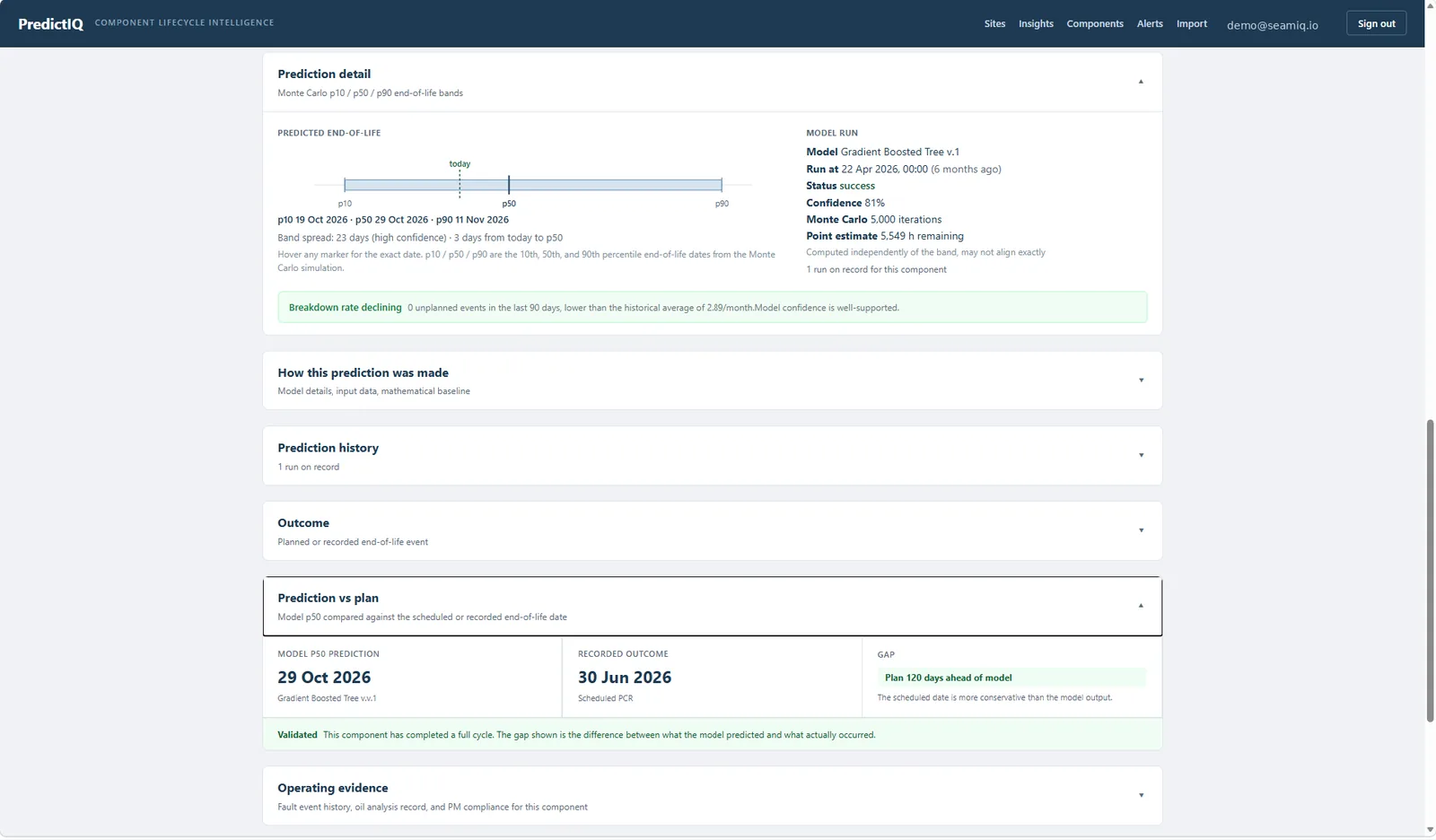
Every vendor says predictive. Few can show a prediction with a confidence band, the evidence it was made from, and the record of what actually happened. This guide sets out what component life prediction has to deliver on a mine site, the questions that separate a model from a marketing slide, and how PredictIQ answers them.

Condition monitoring tells you the state of a component now: oil analysis wear metals, telematics fault codes, derates, temperatures. It is necessary and most mines have some of it. It does not, on its own, tell you when the component will reach end of life.
Prediction takes the condition evidence, the hours on the component, the utilisation rate and the application severity, and estimates the end-of-life date. A good prediction is a distribution, not a date: the earliest credible date, the median and the latest, with the band width stating how sure the model is. A single date without a band is false precision, and planning a rebuild on it is betting production on the median.
The manufacturer's target life for a component is arithmetic on a design assumption. Application severity, operator behaviour, ground conditions and maintenance quality move the real number by thousands of hours in either direction. The centreline estimate (hours to target at the current utilisation) is useful as a baseline. It is not a prediction.
Experienced reliability teams already know this and many have built their own predictive methods: regressions on utilisation, wear models on oil analysis, Monte Carlo simulations for the band. The method lives in a spreadsheet on one laptop, runs when someone has time, cannot be checked against outcomes at scale, and leaves when the person does.
The operational question is rarely about one component. It is which of thirty components across eight trucks the planner should act on first, and whether seven of them reaching end of life in the same half-year will overwhelm the workshop. Prediction has to rank the fleet, not just describe a part.
When predictive capability is embedded in a vendor's platform, the methodology belongs to the vendor and the capability ends with the contract. A dealer or mine that has invested years in a predictive method should expect to run it on a platform that operationalises the method while leaving the model files, the feature engineering and the IP with the people who built them.
Every component replacement is a bet on a date. Too late and the failure picks the time and place. Too early and the hours left in the component are thrown away. Neither shows up as a line called 'wrong date'.
Put these to any vendor, SEAMIQ included, and ask to see each one working on a screen with your own data.
PredictIQ is the execution layer for a predictive method. It ingests the operating evidence, runs your model (or the platform baseline) against live data, writes p10, p50 and p90 dates with confidence, ranks the fleet, puts the evidence on the same page as the number, and records every prediction against the outcome. The models and the methodology stay yours.

Pick a component type you lose sleep over. Send the install hours, the machine hours and whatever evidence you hold. We put it through PredictIQ and show you the band, the ranking and the evidence page with your data.
Or email us directly: info@seamiq.io